About 189 minutes
Some architectural problems of to-day — Themes and Context
Design Photography
43,392 recorded words. 27 minutes difference from this book's estimate.
View Gutenberg source #70018
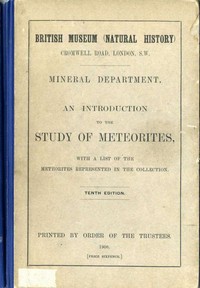
Before opening An Introduction to the Study of Meteorites With a List of the Meteorites Represented in the Collection — Background and Themes, the edition data offers a quick orientation: 37,258 words, 2 hr 42 min estimated reading time, and 10 detected text sections.
The text analysis averages about 12.7 words per sentence, while the detected sections provide another way to judge how the source is divided.
Project Gutenberg metadata also associates the work with “Meteorites,” connecting these edition facts with the source record’s subject description.
Explore this collection
These alternatives are selected using recorded categories and estimated reading time.
About 189 minutes
Design Photography
43,392 recorded words. 27 minutes difference from this book's estimate.
View Gutenberg source #70018About 198 minutes
Design Photography
45,507 recorded words. 36 minutes difference from this book's estimate.
View Gutenberg source #72598About 74 minutes
Design Photography
16,854 recorded words. 88 minutes difference from this book's estimate.
View Gutenberg source #69846Search stored excerpts and compare books → Choose by your preferences →
Choices use stored catalog measurements. Estimates vary with reading speed. A shared category is a catalog label, not a claim that two books have the same argument or literary quality.
Search reads excerpt text stored with this catalog and links to its associated Gutenberg record. The connection is stored in the site database; this tool does not recheck that every excerpt is word-for-word identical to that external record. Excerpt search does not cover every chapter and does not verify historical publication dates.
Catalog snapshot checked: 2026-09-26. Coverage: 93 public books, 93 available source excerpts.
Calculated from edition completeness, EPUB availability, text structure and catalogue metadata. Not a user rating.
Total of 100 points, scaled to a 2.5-5.0 range. Editions with an empty description or a missing EPUB file are not scored.
Public-domain source text
The source text is kept in the dedicated reader, separate from this catalogue record and its commentary.
This tenth edition of the British Museum's guide to meteorites, prepared by Keeper of Minerals L. Fletcher in 1908, serves a dual purpose: it offers a concise scientific introduction while functioning as a precise inventory of the museum's holdings. The catalog entries, organized by chemical type (siderites, siderolites, aerolites), record each specimen's provenance, discovery circumstances, and weight in grams. Fletcher's preface notes the challenge of inconsistent dates across museum publications, and he has verified each date against published fall reports. The result is a document that reveals as much about early 20th-century curatorial practice as about meteorites themselves.
The list entries do more than name specimens. For each meteorite, Fletcher provides a brief extract from the best available report and a reference to the original publication. The Bitburg iron, for instance, was dug up around 1807, taken to Trèves, put into a furnace, thrown away, and later re-discovered in 1824 after fragments were recognized as meteoric. The Elbogen meteorite had been preserved for centuries at the Rathhaus before its meteoric origin was recognized in 1811. These narratives highlight the detective work required to authenticate specimens before modern analytical techniques.
Fletcher also includes a separate list of pseudo-meteorites—objects once mistaken for meteorites—and a list of casts. This systematic approach to verification reflects the museum's role as an arbiter of scientific authenticity.
The book's title promises an introduction to the study of meteorites, but the excerpts show that the introductory section is brief (the table of contents places it on page 17, after the arrangement and history of the collection). The bulk of the volume is the catalog itself. The introduction likely covers basic classification and fall phenomena, but the excerpts do not reveal its depth. Readers seeking a comprehensive textbook on meteoritics will find instead a museum guidebook—one that assumes the visitor has already seen the specimens in the gallery. The plan of the Mineral Gallery and directions for reaching the department reinforce this orientation.
The catalog entries, arranged topographically for specimens without recorded fall circumstances, reveal clusters of finds. European meteorites dominate, with many from Germany, Bohemia, Hungary, and Russia. Several entries note that specimens were found during road-building or draining fields—accidental discoveries by workers, not systematic searches. The dates of discovery span from the early 1800s to the 1890s, with some specimens recognized as meteoric only years later. The list of recent additions (since 1904) shows that the collection continued to grow. This geographical and temporal data, though not analyzed by Fletcher, offers raw material for studying 19th-century meteorite recovery patterns.
Readers should approach this work as a period-specific reference rather than a modern introduction. The catalog's meticulous documentation—weights, references, and discovery stories—makes it valuable for tracing the history of individual meteorites. The introductory section, while concise, reflects the state of meteorite science in 1908. For researchers, the list of pseudo-meteorites and the index provide additional entry points into the museum's collection and the era's scientific practices.
Holding this 1908 museum guide, I thought of my grandfather’s old photo albums—specimens preserved under glass, each labeled in tidy script. The Barnet Book of Photography: A Collection of Practical Articles — A Reader’s Guide once gave me that same quiet ache: a craft where everything is pinned down, yet somehow the mystery remains warm beneath the cataloguing.
Create a short personal record of your experience with this book.