About 530 minutes
Illustrations of the Huttonian Theory of the Earth — Key Ideas to Explore
Architecture
121,849 recorded words. 401 minutes difference from this book's estimate.
View Gutenberg source #67331
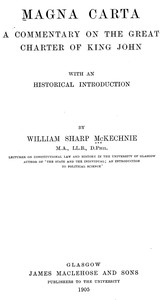
Magna Carta: A Commentary on the Great Charter of King John With an Historical Introduction — Key Ideas to Explore can be approached with a clearer sense of reading commitment from its source measurements: 213,940 words, 15 hr 31 min estimated reading time, and 42 detected text sections.
The text analysis averages about 20.8 words per sentence, while the detected sections provide another way to judge how the source is divided.
Project Gutenberg metadata also associates the work with “Law -- England -- History,” connecting these edition facts with the source record’s subject description.
Explore this collection
These alternatives are selected using recorded categories and estimated reading time.
About 530 minutes
Architecture
121,849 recorded words. 401 minutes difference from this book's estimate.
View Gutenberg source #67331About 515 minutes
Architecture
118,354 recorded words. 416 minutes difference from this book's estimate.
View Gutenberg source #77067About 444 minutes
Architecture
102,031 recorded words. 487 minutes difference from this book's estimate.
View Gutenberg source #36462Search stored excerpts and compare books → Choose by your preferences →
Choices use stored catalog measurements. Estimates vary with reading speed. A shared category is a catalog label, not a claim that two books have the same argument or literary quality.
Search reads excerpt text stored with this catalog and links to its associated Gutenberg record. The connection is stored in the site database; this tool does not recheck that every excerpt is word-for-word identical to that external record. Excerpt search does not cover every chapter and does not verify historical publication dates.
Catalog snapshot checked: 2026-09-26. Coverage: 93 public books, 93 available source excerpts.
Calculated from edition completeness, EPUB availability, text structure and catalogue metadata. Not a user rating.
Total of 100 points, scaled to a 2.5-5.0 range. Editions with an empty description or a missing EPUB file are not scored.
Public-domain source text
The source text is kept in the dedicated reader, separate from this catalogue record and its commentary.
McKechnie's commentary opens with a pointed observation: no modern analysis of Magna Carta had been written from the standpoint of early twentieth-century research, leaving Coke (1642) and Thomson (1829) as the last comprehensive works. The author positions his study as a response to this gap, aiming to treat the Charter not as a static relic but as a document whose meaning shifted through centuries of interpretation. The preface signals a methodical approach: each clause is examined against contemporary legal practice, chronicle evidence, and the political circumstances of 1215. McKechnie warns readers that the Charter's provisions often reflect temporary compromises rather than abstract principles—a caution that shapes the entire work.
McKechnie insists that Magna Carta must be read as a legal instrument, not a philosophical manifesto. He traces the wording of clauses back to specific grievances: the regulation of scutage, the limits on royal purveyance, and the requirement that common pleas be heard at Westminster. The commentary repeatedly shows how the barons' demands were framed in concrete terms—for example, the famous clause 39 (due process) is tied to the practice of royal justices traveling with the king, which forced litigants to pursue the court across the country. By grounding each provision in procedural reality, McKechnie demonstrates that the Charter's power lay in its enforceability, not its rhetoric.
A recurring theme is the struggle over where justice could be administered. McKechnie devotes careful attention to the evolution of the common bench and the king's bench, showing how clause 17 (common pleas at Westminster) was not a sudden innovation but the culmination of experiments under Henry II. He notes that the 1178 ordinance had already created a panel of five judges to hear ordinary suits, yet these judges were initially required to remain with the king. By 1215, the barons demanded that common pleas be fixed in one place—a change that McKechnie links to the growing professionalization of the judiciary. The commentary traces how this clause was later enforced: in 1238, a litigant at Worcester successfully objected that his common plea could not be heard there, citing Magna Carta.
McKechnie frequently invokes earlier charters and legal customs to explain the origins of Magna Carta's clauses. He compares the Charter of Liberties of Henry I, the Coronation Charter of Stephen, and the unknown charter of Henry II, showing how each contributed language or concepts. The commentary also examines the Charter's afterlife: how later monarchs reissued it with modifications, and how medieval lawyers used it to argue cases. McKechnie is careful to distinguish between what the Charter originally meant and what later generations claimed it meant—a distinction that remains central to modern scholarship. He notes, for instance, that clause 39 was later interpreted as guaranteeing trial by jury, though the original text did not specify that procedure.
The ordering of clauses, McKechnie argues, reflects the barons' immediate concerns rather than a systematic legal code. He points out that the first clauses address church liberties and feudal incidents—issues closest to the barons' interests—while later clauses deal with trade, forests, and local administration. The commentary highlights how certain provisions were inserted at the last moment, such as the clause on removing fish-weirs from rivers, which suggests the influence of specific interest groups. McKechnie also notes the absence of any clause on representation or parliament, reminding readers that the Charter was a feudal compact, not a democratic constitution. This structural analysis helps explain why some clauses became obsolete while others endured.
Readers approaching this commentary should expect a dense, clause-by-clause analysis that rewards careful attention. McKechnie's method—combining legal history, textual criticism, and political narrative—offers a model for understanding how a medieval document could shape centuries of constitutional debate. The work is best used alongside the Charter text itself, as the commentary assumes familiarity with the original Latin and its translation. For those interested in the mechanics of medieval governance, this remains an indispensable resource.
That grey afternoon, the rain blurring my windows, I lost myself in Magna Carta's cautious clauses, imagining barons arguing over liberties under dripping trees. A footnote mentioned Charles Martel, and somehow the damp air made medieval France feel closer. Later, I found the old volume waiting, unasked: Moslem and Frank; or, Charles Martel and the rescue of Europe from the threatened yoke of the Saracens — Context and Discussion. One quiet thread led to another, as it always does.
Your answers remain private and are stored only in this browser.









