About 439 minutes
The Church of Sancta Sophia, Constantinople: A Study of Byzantine Building — Edition Insights
Architecture
100,967 recorded words. 14 minutes difference from this book's estimate.
View Gutenberg source #66302
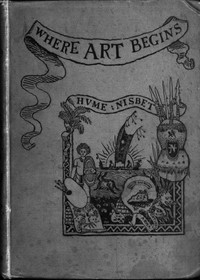
This digital edition of Where Art Begins — Inside the Classic is described by source-level measurements including 97,743 words, 7 hr 5 min estimated reading time, and 10 detected text sections.
The text analysis averages about 35.6 words per sentence, while the detected sections provide another way to judge how the source is divided.
Project Gutenberg metadata also associates the work with “Art,” connecting these edition facts with the source record’s subject description.
Explore this collection
These alternatives are selected using recorded categories and estimated reading time.
About 439 minutes
Architecture
100,967 recorded words. 14 minutes difference from this book's estimate.
View Gutenberg source #66302About 442 minutes
Architecture
101,621 recorded words. 17 minutes difference from this book's estimate.
View Gutenberg source #43320About 444 minutes
Architecture
102,031 recorded words. 19 minutes difference from this book's estimate.
View Gutenberg source #36462Search stored excerpts and compare books → Choose by your preferences →
Choices use stored catalog measurements. Estimates vary with reading speed. A shared category is a catalog label, not a claim that two books have the same argument or literary quality.
Search reads excerpt text stored with this catalog and links to its associated Gutenberg record. The connection is stored in the site database; this tool does not recheck that every excerpt is word-for-word identical to that external record. Excerpt search does not cover every chapter and does not verify historical publication dates.
Catalog snapshot checked: 2026-09-26. Coverage: 93 public books, 93 available source excerpts.
Calculated from edition completeness, EPUB availability, text structure and catalogue metadata. Not a user rating.
Total of 100 points, scaled to a 2.5-5.0 range. Editions with an empty description or a missing EPUB file are not scored.
Public-domain source text
The source text is kept in the dedicated reader, separate from this catalogue record and its commentary.
Hume Nisbet, himself an artist and teacher, writes about illustration with a practitioner's eye for technique. In the excerpts, he contrasts Cruikshank's "subtlety of lines" and "expression which he was able to give with the least labour" with Doré's "frantic hurry" and use of "a black ground with a few dashes of light and half-tone." These are not vague appreciations but specific, comparative judgments grounded in observable features of the work.
Nisbet praises Cruikshank's "correctness of drawing" while acknowledging that it might be "objected to," yet he insists that no one could surpass his "knowledge of chiaro-oscuro and balancing of parts." The key phrase is "subtlety of his lines"—Nisbet values the minimal effort that yields maximum expression. He points to crowded scenes like "Lord Mayor's Day" in the Comic Almanack as a source of inspiration for later cartoonists such as Harry Furniss. This is not mere name-dropping; Nisbet uses a concrete example to trace a lineage of technique.
Nisbet describes Doré's approach as a break from tradition: instead of working on a white ground with thin washes and hatching, Doré used "a black ground with a few dashes of light and half-tone." He cites "The Vision of Death" as a prime example, calling it "flimsy yet immensely clever" and notes that Doré likely produced it "in about half an hour." Nisbet's language—"extravagant and theatrical," "atrociously coarse and unsatisfactory"—is blunt, but he balances criticism with recognition of Doré's influence: he "gave an impulse to book-plate work" and made later artists "more courageous and less afraid of their masses."
Nisbet identifies a recurring compositional pattern in Doré: "He fixed on a single light, and set to gathering as much shadow about it as possible,—a broad light, in which he placed as many of his characters as he could cram,—and then set to fill out the shadows with as much detail as he could cram into them." The repetition of "cram" is deliberate, suggesting a method that is both energetic and overcrowded. Nisbet lists examples—"The Prince in the Banqueting Hall," "The Mouth of Hell," "The Gathering of the Waters"—to show that this is a consistent, not occasional, feature.
Nisbet interrupts his technical analysis to remark on the character Ally Sloper, calling him "a distinct creation" alongside the Elder McNab. He notes that he has "watched the natural progress of the old humbug" for twenty years and still reads about his doings "with undiminished pleasure." This is not a digression; it illustrates Nisbet's criterion for artistic success: the ability to sustain a character without wearying readers. He calls this "the surest test of his vitality," a principle that applies as much to illustration as to fiction.
Nisbet situates Doré's work "before the revolution which photography caused in illustrative art," implying that photography changed the standards of finish and accuracy. Doré's "frantic hurry" and "sketchy" style were a reaction against the slow, meticulous methods of earlier draughtsmen. Nisbet does not elaborate on photography's impact here, but the remark frames his entire discussion: the excerpts are as much about the changing conditions of illustration as about individual artists.
Nisbet writes as a working artist, not a theorist. His observations are grounded in specific works and techniques, and he is unafraid to mix praise with blunt criticism. Readers interested in the craft of illustration—particularly the choices behind line, light, and composition—will find his commentary instructive. The excerpts offer a focused look at two major figures, but Nisbet's method of close attention to technical detail can be applied to any visual art.
I was rereading the passage on Doré’s cross-hatching, the way light gets trapped in those dark valleys, and it made me think of that old fascination with Earth dams, a study — Key Ideas to Explore. Both feel like conversations about pressure—how a line holds water, how a wall holds back collapse. I haven’t touched that one in years, but the memory lingers, quiet and solid.
A brief reflection can help important ideas stay with you longer.









