
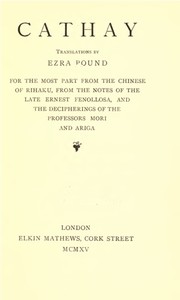
Cathay by Ezra Pound and Bai Li
Let's clear something up first. 'Cathay' isn't a direct translation of Li Bai's work. Li Bai was a legendary Tang Dynasty poet, famous for his poems about wine, friendship, and the natural world. Over a thousand years later, the American poet Ezra Pound created 'Cathay' using the rough notes of Ernest Fenollosa, a scholar who had studied classical Chinese poetry. Pound didn't read Chinese. Instead, he took Fenollosa's literal interpretations and notes on imagery and turned them into poems in English.
The Story
There isn't a plot in the traditional sense. The 'story' is the journey of these poems themselves. Pound selected about a dozen pieces attributed to Li Bai (and a couple by other poets). He focused on poems about exile, loss, longing for home, and the passage of time—themes that resonated deeply during the turmoil of World War I. Poems like 'The River Merchant's Wife: A Letter' tell a simple, heartbreaking story of separation. Others, like 'The Exile's Letter,' capture the deep ache of friendship and memory. Pound strips away ornamentation, leaving behind clean, vivid images: a river merchant's wife watching moss grow, a soldier far from home hearing a bird cry. The narrative is emotional, not linear.
Why You Should Read It
You should read it because it's a miracle of creative misunderstanding. Pound wasn't trying to be academically perfect. He was trying to make the feeling of the poems live again in English. And he succeeded wildly. The language is so clear and sharp it cuts right to the bone. Reading 'Cathay,' you get two incredible poets for the price of one: the distant, romantic spirit of Li Bai and the fierce, modernist energy of Ezra Pound. It's like listening to a beautiful duet where the singers are centuries apart. It makes you think about what translation really is—is it about words, or is it about capturing a spirit?
Final Verdict
This book is perfect for anyone curious about how art travels across time and culture. It's for poetry lovers who want to see where the clean, image-driven style of 20th-century poetry got some of its spark. It's also for readers who enjoy a bit of literary detective work, piecing together where Li Bai ends and Pound begins. If you want a pure, unadulterated dose of classical Chinese poetry, you might start elsewhere. But if you want to experience one of the most influential and strangely beautiful creative collaborations in literary history, 'Cathay' is an essential, mind-bending read.
The copyright for this book has expired, making it public property. Distribute this work to help spread literacy.
Barbara Davis
10 months agoBeautifully written.
Carol Thompson
10 months agoGreat read!

Margaret Brown
9 months agoAfter spending a few days with this digital edition, it manages to maintain a consistent flow even when discussing difficult topics. The insights gained here are worth every minute of reading.