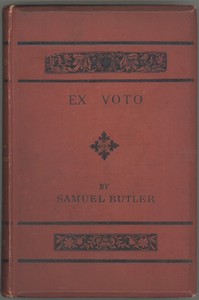
Butler opens his account with a frank admission of changed opinion: he now inclines against his earlier view that Michael Angelo Rossetti was the principal sculptor of the Massacre of the Innocents chapel. The signature on one figure, he concedes, likely governed only that piece, not the whole composition. This willingness to revise—and to weigh external authority against internal evidence—sets the tone for a work that treats attribution as a matter of careful inference rather than settled fact.
The book is structured as a chapel-by-chapel tour, but it is no mere guidebook. Butler constantly compares hands: a sleeping St. Joseph by Tabachetti is judged “greatly better” than a second sleeping St. Joseph in another chapel, and he notes that sleep is “the easiest of all subjects, except a dead one,” because nature cannot shift the pose. Such remarks reveal an eye trained on the practical challenges of terra-cotta sculpture.
Attribution as Detective Work
Butler treats authorship not as a label but as a problem. He cites Fassola, Torrotti, Bordiga, and Colombo, weighing their dates and documentary evidence against what he calls “internal evidence”—the visible advance in style from one chapel to the next. For the Magi chapel frescoes, he notes that the difference from the Crucifixion chapel is so wide that “an interval of ten years or so is not too much to allow.” He compares Gaudenzio Ferrari to Giovanni Bellini, “a slow but steady grower from first to last,” and insists that with such painters “we can be more sure that as long as they lived they were taking pains.”
Butler does not hide uncertainty. He presents conflicting authorities and admits when he has changed his mind. The reader is drawn into a process of sifting clues: a signature, a stylistic leap, a missing document. The result is a study that feels less like a final verdict than an ongoing conversation with earlier scholars.
The Sculptor’s Craft and the Limits of Likeness
Butler’s descriptions of individual figures are precise and technical. He praises Tabachetti’s St. Joseph as “among the finest on the Sacro Monte,” but immediately qualifies: a sleeping figure is easier than a waking one because “Nature does not here play against the artist with loaded dice.” The compliment is real, but it is measured against the inherent difficulty of the subject.
He notes that the Madonna in the same chapel is “a very pretty and graceful figure” sewing on a pillow, “unmoved by the presence of the angel, who is only visible to her husband.” The observation ties pose to narrative: the angel’s invisibility to the viewer is part of the composition’s logic. Butler’s eye for such details—the way a figure’s stillness or activity serves the story—gives his criticism a practical, almost workshop-based feel.
Dating by Style and Circumstance
Butler dates Tabachetti’s last work at Varallo to early 1591, reasoning that the artist “must have recovered his reason and was on the point of leaving Varallo for ever.” The biographical detail—Tabachetti’s mental illness—is used as a chronological marker. Similarly, he argues that the Magi chapel frescoes were painted between 1536 and 1539 because Gaudenzio Ferrari “was already established at Vercelli” by 1528 and left no trace elsewhere during those years.
This method blends documentary gaps with stylistic inference. Butler is candid about the limits: “Fassola may have only intended … that the shell of the building was completed by 1520, the figures and frescoes being deferred for want of funds.” He does not pretend to certainty, but he shows how a plausible sequence can be built from fragmentary evidence.
The Role of the Viewer and the Problem of Reproduction
Butler is acutely aware that his book cannot fully convey the experience of the Sacro Monte. He regrets that collotype photographs, despite the care of the printers, are not equal to photogravure, but cost forced the choice. He quotes Miss Alice Greene’s description of the terra-cotta figures as so lifelike that “were a man of flesh and blood to get mixed up … you would have hard work to distinguish him.” The quotation underscores the illusionistic ambition of the sculptures, which Butler’s own text tries to capture in words.
He also notes that the Magi frescoes “have unfortunately suffered from damp much more than the Crucifixion ones.” The physical decay of the works is part of their history, and Butler records it without sentimentality. His account is as much about what has been lost or altered as about what remains.
Butler’s Ex Voto is best read as a working notebook of a connoisseur: tentative, precise, and willing to contradict itself. The reader who expects a definitive catalogue will be frustrated; the reader who enjoys watching a knowledgeable mind weigh evidence will find much to admire. Butler’s voice—dry, self-correcting, occasionally wry—makes the technicalities of attribution and dating feel like a detective story told by a man who knows he may be wrong.
I remember years spent with Butler's Ex Voto, his careful hands tracing those terra-cotta figures, the quiet patience of an eye seeking intention behind the clay. Strangely, it often reminds me of a little volume, Lectures on popular and scientific subjects — Key Ideas to Explore, for both share that unhurried wonder—the world made more dear by looking closely, feeling the warmth in the meticulousness.