About 150 minutes
Arts and crafts of old Japan — A Reader’s Guide
Architecture
34,290 recorded words. 14 minutes difference from this book's estimate.
View Gutenberg source #76830
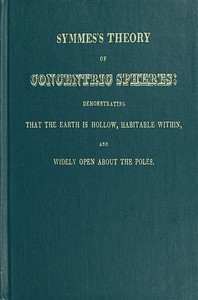
Symmes's Theory of Concentric Spheres Demonstrating that the Earth is hollow, habitable within, and widely open about the poles — Themes and Context can be approached with a clearer sense of reading commitment from its source measurements: 37,612 words, 2 hr 44 min estimated reading time, and 20 detected text sections.
The text analysis averages about 34.6 words per sentence, while the detected sections provide another way to judge how the source is divided.
Project Gutenberg metadata also associates the work with “Earth (Planet) -- Miscellanea,” connecting these edition facts with the source record’s subject description.
Explore this collection
These alternatives are selected using recorded categories and estimated reading time.
About 150 minutes
Architecture
34,290 recorded words. 14 minutes difference from this book's estimate.
View Gutenberg source #76830About 146 minutes
Architecture
33,471 recorded words. 18 minutes difference from this book's estimate.
View Gutenberg source #67639About 144 minutes
Architecture
32,941 recorded words. 20 minutes difference from this book's estimate.
View Gutenberg source #30562Search stored excerpts and compare books → Choose by your preferences →
Choices use stored catalog measurements. Estimates vary with reading speed. A shared category is a catalog label, not a claim that two books have the same argument or literary quality.
Search reads excerpt text stored with this catalog and links to its associated Gutenberg record. The connection is stored in the site database; this tool does not recheck that every excerpt is word-for-word identical to that external record. Excerpt search does not cover every chapter and does not verify historical publication dates.
Catalog snapshot checked: 2026-09-26. Coverage: 93 public books, 93 available source excerpts.
Calculated from edition completeness, EPUB availability, text structure and catalogue metadata. Not a user rating.
Total of 100 points, scaled to a 2.5-5.0 range. Editions with an empty description or a missing EPUB file are not scored.
Public-domain source text
The source text is kept in the dedicated reader, separate from this catalogue record and its commentary.
The title page alone signals the ambition of this 1826 work: it promises to demonstrate that the Earth is hollow, habitable within, and widely open about the poles. The author, styling himself "A Citizen of the United States," frames the argument as a challenge to conventional geology. Two epigraphs—from Shakespeare and Milton—set a defensive yet earnest tone, urging readers not to dismiss novel ideas out of hand. The text begins not with abstract theory but with a personal puzzle: how can earthquakes violently shake one region without affecting the whole globe, if the Earth is solid? This question, drawn from the author's experience on the Mississippi River during the 1811–1812 New Madrid earthquakes, grounds the speculative theory in a concrete, observed phenomenon.
The author's most compelling evidence comes from firsthand observation. In 1812, he was on the Mississippi River when the region was "violently convulsed with an earthquake." He describes hearing "innumerable explosions, as though a large quantity of air had been confined in the bowels of the earth," forcing up sand, black muddy water, and a substance resembling stone coal. The river stopped, then briefly flowed backward with "astonishing velocity," bending trees upstream. The ground near New Madrid sank about five feet and remained sunken eight years later. These details are not merely dramatic; they serve as the empirical foundation for the theory. The author repeatedly asks: if the Earth is a solid globe, how can such localized convulsions occur without being felt elsewhere? Where did the expelled water and air come from? His answer is that the Earth's interior contains hollow spaces and fluids that, when suddenly rarified, cause the surface to elevate and rupture.
Before presenting his own model, the author systematically challenges the prevailing solid-Earth hypothesis. He points to the sinking of whole islands and the rising of new ones from the ocean floor as phenomena inconsistent with a dense, compact interior. "If the globe be solid," he asks, "on what principle could a large portion of its surface, which is said to be lighter than the parts beneath, sink into a dense medium?" Similarly, how could a heavy mass rise from a thousand fathoms deep against an "opposite and immutable tendency"? These are presented as logical contradictions—"a solecism in nature." The author's tone is that of a rational inquirer, not a mystic. He does not appeal to divine intervention or unknown forces; instead, he insists that the solid-Earth model fails to account for plain facts. The reader is invited to see the hollow-Earth theory not as a wild fancy but as the only way to resolve these contradictions into "the most simple principles."
The book proceeds by laying out a series of propositions, each building on the last. The author first establishes the inadequacy of the solid model, then introduces his alternative: a series of concentric spheres, each habitable, with openings at the poles allowing access to the interior. The reasoning is deductive, moving from observed anomalies to a general theory that explains them. The excerpts show a methodical mind at work, using analogy and thought experiments. For instance, the behavior of gases and fluids under pressure is invoked to explain earthquakes and volcanic eruptions. The author does not claim to have explored the interior; rather, he argues that the theory fits the evidence better than its rivals. The reader should note that the text is structured as a sustained argument, not a collection of anecdotes. Each chapter likely addresses a specific objection or presents a new line of evidence, though the excerpts do not reveal the full sequence.
Because the excerpts are limited to the opening pages and a later passage on earthquakes, the reader cannot assume the entire book follows the same pattern. The theory may be developed through mathematical or astronomical arguments not represented here. The author's reliance on personal observation suggests a practical, empirical bent, but later sections might engage with contemporary scientific debates or respond to critics. The epigraph from Milton, urging "gentle meetings and a gentle dismission" for those who "set forth new positions," hints that the author expected skepticism. The reader should approach the text as a period piece in the history of science, noting how the author marshals evidence from natural phenomena to support a radical hypothesis. The earthquake narrative is the most vivid part of the excerpts; it is worth comparing how the author uses it to ground his theory in lived experience.
This edition preserves the original 1826 text, including the copyright page and the author's preface. Readers interested in the history of American science or speculative geology will find here a earnest attempt to reconcile observation with theory. The earthquake description, in particular, offers a rare firsthand account of the New Madrid seismic zone. As you read, note how the author balances personal testimony with logical argument—and consider what other evidence the full book might bring to bear on its extraordinary claim.
Some old books whisper across the shelves to one another. I’ve often found Symmes's Theory speaking to Magna Carta: A Commentary on the Great Charter of King John With an Historical Introduction — Key Ideas to Explore, both arguing the ground beneath our feet—physical or political—hides deeper chambers, waiting patiently for a patient ear. Each trusts that what is written can overturn what is assumed.
Answer a few questions and save a private reflection on this device.









