About 263 minutes
Chats on Old Copper and Brass — Reading Notes
Architecture
60,418 recorded words. 6 minutes difference from this book's estimate.
View Gutenberg source #47040
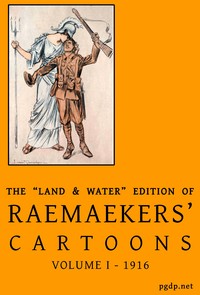
This digital edition of The "Land & Water" edition of Raemaekers' cartoons, volume 1 — Inside the Classic is described by source-level measurements including 61,685 words, 4 hr 29 min estimated reading time, and 163 detected text sections.
The text analysis averages about 23.2 words per sentence, while the detected sections provide another way to judge how the source is divided.
Project Gutenberg metadata also associates the work with “World War, 1914-1918 -- Caricatures and cartoons,” connecting these edition facts with the source record’s subject description.
Explore this collection
These alternatives are selected using recorded categories and estimated reading time.
About 263 minutes
Architecture
60,418 recorded words. 6 minutes difference from this book's estimate.
View Gutenberg source #47040About 262 minutes
Architecture
60,245 recorded words. 7 minutes difference from this book's estimate.
View Gutenberg source #26638About 278 minutes
Architecture
63,852 recorded words. 9 minutes difference from this book's estimate.
View Gutenberg source #31415Search stored excerpts and compare books → Choose by your preferences →
Choices use stored catalog measurements. Estimates vary with reading speed. A shared category is a catalog label, not a claim that two books have the same argument or literary quality.
Search reads excerpt text stored with this catalog and links to its associated Gutenberg record. The connection is stored in the site database; this tool does not recheck that every excerpt is word-for-word identical to that external record. Excerpt search does not cover every chapter and does not verify historical publication dates.
Catalog snapshot checked: 2026-09-26. Coverage: 93 public books, 93 available source excerpts.
Calculated from edition completeness, EPUB availability, text structure and catalogue metadata. Not a user rating.
Total of 100 points, scaled to a 2.5-5.0 range. Editions with an empty description or a missing EPUB file are not scored.
Public-domain source text
The source text is kept in the dedicated reader, separate from this catalogue record and its commentary.
The volume opens with a table of contents listing over 100 cartoon titles, many of which—like 'The Massacre of the Innocents,' 'The Gas Fiend,' and 'The Widows of Belgium'—signal a sustained focus on German atrocities. The introductory material, including an 'Appreciation from the Prime Minister' and a note by Father Bernard Vaughan, establishes the cartoons as wartime propaganda aimed at mobilizing public opinion against Germany. Vaughan's text, for instance, contrasts a vision of 'a land beyond the stars' with the immediate horrors of war, framing the cartoons as a moral indictment.
The early excerpts also reveal a pattern of pairing each cartoon with a prose commentary. In 'The Widows of Belgium,' the commentary by Eden Phillpotts directly accuses Germany of 'frightfulness' and cites specific Hague Convention articles (Nos. 46 and 47) to argue that German actions constitute war crimes. This legalistic framing recurs throughout the volume, suggesting that the cartoons are not merely visual satire but part of a broader argument about international law and justice.
The volume's organization is itself a rhetorical device. The table of contents groups cartoons under thematic headings such as 'Christendom After Twenty Centuries' and 'The Massacre of the Innocents,' creating a narrative arc from religious betrayal to specific atrocities. Each cartoon is followed by a prose commentary that often cites legal or historical precedents. For example, in the excerpt titled 'Military Necessity,' Phillpotts invokes the Hague Regulations and compares Germany's plea to that of a common criminal: 'Bill Sikes may justly claim “military necessity” for his thefts and murders, if Germany can do so for hers.' This pattern of pairing image with legal argument recurs throughout, suggesting that the volume aims to build a case for post-war accountability.
The commentaries also frequently reference other sources, such as 'Germany's Violations of the Laws of War,' a book Phillpotts recommends for the Peace Conference. This intertextuality reinforces the volume's function as a documentary record, not just a collection of cartoons.
From the titles alone, several motifs emerge: the contrast between 'Kultur' and civilization, the personification of nations (e.g., 'The German Tango,' 'The Latin Sisters'), and the use of religious imagery ('Christ or Odin?', 'The Holy War'). The cartoon 'The Gas Fiend' and 'Liquid Fire' point to a focus on new weapons of war, while 'The Zeppelin Triumph' and 'The Sea Mine' address specific German tactics. The commentaries amplify these visual themes by providing historical context. For instance, in 'Liberté! Liberté, Chérie!', the text references 'the Huns tore up that scrap of paper'—a phrase that recurs in multiple excerpts, linking the violation of Belgian neutrality to a broader pattern of perfidy.
The volume also includes cartoons that target individuals, such as 'Fox Tirpitz' and 'Ferdinand Juggernaut,' suggesting a personalization of the enemy. This blend of allegorical and specific figures creates a layered visual argument that the commentaries help unpack.
The prose commentaries, written by Eden Phillpotts and others, are not mere captions but extended essays that often exceed the space given to the cartoons. In 'The Widows of Belgium,' the commentary runs several paragraphs, citing legal articles and historical precedents. This imbalance suggests that the cartoons serve as entry points for a broader polemic. The commentaries also employ a distinctive rhetorical style: they are passionate, accusatory, and occasionally sarcastic, as when Phillpotts imagines a convict saying, 'The next time I'll wear a German helmet and plead “military necessity.”'
Notably, the commentaries do not always directly describe the cartoon's content. Instead, they use the cartoon as a springboard for legal or moral argument. This independence means that the volume can be read either as a visual narrative or as a series of essays, with the cartoons providing emotional reinforcement.
The excerpts span the volume's early and later sections, revealing a shift in tone. Early commentaries, such as those in 'The Massacre of the Innocents,' focus on immediate outrage and the violation of Belgian neutrality. Later excerpts, like 'Military Necessity,' adopt a more legalistic tone, discussing post-war justice and the need for 'police supervision of Europe.' This progression suggests that the volume was designed to move from emotional appeal to reasoned argument, building a case for the treatment of Germany after the war.
The final excerpt, 'Liberté! Liberté, Chérie!', returns to a more hopeful note, referencing 'the wonderful upleap to the needs of the times by Great, and still more by Greater Britain.' This cyclical structure—from outrage to legalism to resilience—mirrors the wartime narrative the volume seeks to promote. However, because the excerpts are incomplete, it is unclear whether this pattern holds throughout the entire book.
Readers approaching this volume should pay attention to the interplay between image and text. The cartoons are often symbolic, while the commentaries are concrete and legalistic. Noting how each section uses specific historical references—such as the Hague Conventions or the 'scrap of paper'—can illuminate the volume's dual purpose as both propaganda and a documentary record. The table of contents also rewards browsing, as the sequence of titles itself tells a story of war, atrocity, and the hope for justice.
That rainy afternoon, I kept returning to Raemaekers’ furious ink, how the war crept into every line, until the “military necessity” arguments left me restless. Somehow, I reached for a softer, quieter companion on my shelf, My Sketch Book — Context and Discussion, and found the same conflict rendered in gentler, more human strokes. It felt less like a detour, more like a sigh.
Build a private reading journal entry for this title.









