About 32 minutes
Earthquakes — A Closer Reading
Architecture
7,152 recorded words. 2 minutes difference from this book's estimate.
View Gutenberg source #47340
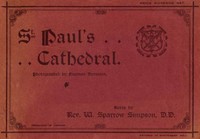
This digital edition of Views of St. Paul's Cathedral, London — Background and Themes is described by source-level measurements including 6,846 words, 30 min estimated reading time, and 1 detected text section.
The text analysis averages about 20.3 words per sentence, while the detected sections provide another way to judge how the source is divided.
Project Gutenberg metadata also associates the work with “St. Paul's Cathedral (London, England),” connecting these edition facts with the source record’s subject description.
Explore this collection
These alternatives are selected using recorded categories and estimated reading time.
About 32 minutes
Architecture
7,152 recorded words. 2 minutes difference from this book's estimate.
View Gutenberg source #47340About 28 minutes
Architecture
6,236 recorded words. 2 minutes difference from this book's estimate.
View Gutenberg source #62597About 35 minutes
Architecture
7,847 recorded words. 5 minutes difference from this book's estimate.
View Gutenberg source #46578Search stored excerpts and compare books → Choose by your preferences →
Choices use stored catalog measurements. Estimates vary with reading speed. A shared category is a catalog label, not a claim that two books have the same argument or literary quality.
Search reads excerpt text stored with this catalog and links to its associated Gutenberg record. The connection is stored in the site database; this tool does not recheck that every excerpt is word-for-word identical to that external record. Excerpt search does not cover every chapter and does not verify historical publication dates.
Catalog snapshot checked: 2026-09-26. Coverage: 93 public books, 93 available source excerpts.
Calculated from edition completeness, EPUB availability, text structure and catalogue metadata. Not a user rating.
Total of 100 points, scaled to a 2.5-5.0 range. Editions with an empty description or a missing EPUB file are not scored.
Public-domain source text
The source text is kept in the dedicated reader, separate from this catalogue record and its commentary.
The volume pairs Freeman Dovaston's photographs with the Rev. Sparrow Simpson's notes, creating a work that moves methodically from the cathedral's exterior to its interior recesses. The sequence of views—beginning with the Western Façade, then circling to the South West, the North West angle, and the South Transept—establishes a deliberate architectural promenade. Simpson's commentary anchors each image in precise measurements, historical dates, and quotations from earlier authorities, such as Fergusson's praise of the dome as "the very crown of England's architectural glory."
The opening photographs document the cathedral from three distinct exterior angles, each chosen to highlight a different structural feature. The view "from the South West" is noted as having been taken from the Post Office Savings Bank before warehouses obscured the lower portion—a rare record of a now-lost perspective. Simpson's note that "the exquisite proportions of the Dome are here displayed to the fullest advantage" ties the image directly to the building's most celebrated element. The North West angle view emphasizes the "noble flight of steps" and the carving on the North Tower, while also recalling that the Bishops' Palace once adjoined that tower. These observations ground each photograph in a specific historical moment, making the images documents of both architecture and urban change.
Two photographs of the crypt anchor the interior section: Nelson's tomb and Sir Christopher Wren's grave. Simpson notes that the sarcophagus intended for Cardinal Wolsey was repurposed by Henry VIII, and that Nelson's body lies "not in the Sarcophagus, but beneath it." Wren's tomb is described as "a singularly modest epitaph"—a black marble slab only sixteen-and-a-half inches high—contrasted with the famous inscription nearby: "Lector, si monumentum requiris, circumspice." The surrounding memorials to artists, politicians, and war correspondents create a dense network of associations, turning the crypt into a microcosm of imperial and cultural memory. Simpson's dry observation that the epitaph is modest "at a period when fulsome phrases abounded" adds a wry editorial note.
The Library section departs from architectural description to inventory the cathedral's collection: early English Bibles, ritual books, sermons, plays by the "Children of Paul's," autographs, and over ten thousand printed books. Simpson highlights specific objects—a model of the Western Front once owned by the master-builder, a large-paper Polyglot Bible, Bishop Compton's Prayer Book of 1662, a Runic stone found in the churchyard, and a chain used to fasten books to shelves. The brackets long attributed to Grinling Gibbons are reassigned to Jonathan Maine, carver, in 1708. This section shifts the reader's attention from stone and space to the smaller, portable artifacts that accumulate within the building, suggesting that the cathedral is not only a structure but a repository.
Throughout the notes, Simpson oscillates between grand measurements and minute particulars. The opening page gives the cathedral's exterior length as 515 feet, the height to the cross as 365 feet, and the cost as "about a million pounds." Later, he notes that Wren's tomb is only sixteen-and-a-half inches high. The dome is praised in Fergusson's sweeping terms, while the Library section lingers on a facsimile of a tonsure plate and a chain. This alternation creates a reading experience that mirrors the physical act of approaching the building: one first takes in its mass, then steps closer to examine carvings, inscriptions, and objects. The photographs, too, shift from full-façade views to interior details, reinforcing the sense of a guided tour that moves constantly between the monumental and the intimate.
The volume concludes with an advertisement listing other titles in the same series—St. Bartholomew the Great, Westminster Abbey, Southwark Cathedral, Christ's Hospital, and a general volume on "Famous Buildings and Street Views." This places the St. Paul's book within a larger project of photographic documentation of London's historic architecture, priced at sixpence each. For the reader, this context suggests that the work is intended as part of a collection, each volume offering a similarly structured combination of image and commentary. The closing note also reminds us that the photographs are not merely illustrations but primary records: the South West view, for instance, captures a scene already altered by new construction.
The interplay between Dovaston's photographs and Simpson's notes invites the reader to move through the cathedral as a sequence of framed views, each accompanied by historical and architectural commentary. The work does not attempt a comprehensive history but instead selects moments—a vanished vista, a modest tomb, a Runic stone—that together suggest the layered life of the building. Readers interested in the cathedral's fabric will find the precise dimensions and material details useful; those drawn to anecdote will discover the stories behind the monuments. The volume rewards a slow, attentive reading that mirrors the careful composition of each photograph.
There’s a particular hush in those old plates of St. Paul’s, how the light falls through the nave before you even reach the choir. It makes me think of the quiet care in tracing a forgery’s hand, that same patience with detail. The guide lingers on what’s real and what’s crafted, much like Forgers and Forgeries — Context and Discussion does. Both feel like keeping company with gentle, obsessive minds.
Save your reaction, strongest insight, and memorable passage.









