About 15 minutes
My Sketch Book — Context and Discussion
Architecture
3,394 recorded words. 0 minutes difference from this book's estimate.
View Gutenberg source #44743
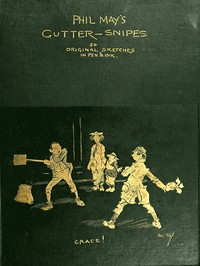
Phil May's Gutter-Snipes: 50 Original Sketches in Pen & Ink — A Closer Reading can be approached with a clearer sense of reading commitment from its source measurements: 3,323 words, 15 min estimated reading time, and 2 detected text sections.
The text analysis averages about 24.4 words per sentence, while the detected sections provide another way to judge how the source is divided.
Project Gutenberg metadata also associates the work with “Caricatures and cartoons -- Great Britain,” connecting these edition facts with the source record’s subject description.
Explore this collection
These alternatives are selected using recorded categories and estimated reading time.
About 15 minutes
Architecture
3,394 recorded words. 0 minutes difference from this book's estimate.
View Gutenberg source #44743About 21 minutes
Architecture
4,699 recorded words. 6 minutes difference from this book's estimate.
View Gutenberg source #62750About 22 minutes
Architecture
5,042 recorded words. 7 minutes difference from this book's estimate.
View Gutenberg source #64526Search stored excerpts and compare books → Choose by your preferences →
Choices use stored catalog measurements. Estimates vary with reading speed. A shared category is a catalog label, not a claim that two books have the same argument or literary quality.
Search reads excerpt text stored with this catalog and links to its associated Gutenberg record. The connection is stored in the site database; this tool does not recheck that every excerpt is word-for-word identical to that external record. Excerpt search does not cover every chapter and does not verify historical publication dates.
Catalog snapshot checked: 2026-09-26. Coverage: 93 public books, 93 available source excerpts.
Calculated from edition completeness, EPUB availability, text structure and catalogue metadata. Not a user rating.
Total of 100 points, scaled to a 2.5-5.0 range. Editions with an empty description or a missing EPUB file are not scored.
Public-domain source text
The source text is kept in the dedicated reader, separate from this catalogue record and its commentary.
Phil May's Gutter-Snipes presents fifty pen-and-ink sketches of London street children, originally issued in 1896 as a limited edition of 1,050 copies on fine paper. The volume's material history—proofs printed with care, followed by a cheaper paper-covered edition—already enacts a social contrast that the drawings themselves explore. May's subjects, the gutter-snipes, are observed with an eye that neither sentimentalizes nor condemns. The transcriber's notes record that apparent printer's errors and blemishes on the illustrations were retained to preserve the authenticity of the original pen and ink work, a decision that respects the texture of May's line and the rough world it depicts.
May's technique relies on swift, uncluttered strokes. The sketches are reproduced as pen-and-ink originals, and the transcriber's note about retaining blemishes suggests that the digital edition aims to preserve the physical character of the drawings—the smudges, the uneven ink, the evidence of a hand moving quickly. This is not a polished, idealized portrait of childhood. The title itself, Gutter-Snipes, signals a focus on children who live in the streets, scavenging and surviving. One caption fragment from the text—'You and I smoke big cigars while they--all too soon, poor little chaps--smoke what you and I and others throw away'—encapsulates the dynamic: the viewer (the comfortable reader) is implicated in the children's circumstances. May does not preach; he lets the contrast between the fine-paper proof and the gutter-snipe's reality do the work.
The book's own production history mirrors its subject. The colophon states that the impressions are 'extra carefully printed as PROOFS on fine paper,' with the issue limited to 1,050 copies, each numbered. Copy 462 is the one digitized. Immediately following is the note that 'a paper-covered edition, on thinner paper, at a popular price, will follow.' This two-tiered release—a luxury object for collectors, then a cheap version for wider circulation—echoes the social stratification May depicts. The gutter-snipes are rendered in a format that, in its first incarnation, would have been affordable only to those who could afford fine paper. The reader holds a digital surrogate of the limited edition, but the popular edition is promised, never quite present. This gap between the artifact and its subject is part of the work's meaning.
May's sketches do not offer easy access to the inner lives of the children. The transcriber's notes indicate that illustrations appear in the same order as the original, but that for numbers 43-50, the order varies from the Table of Drawings. This small disordering is a reminder that the book is a constructed object, not a transparent window. The viewer is positioned as an outsider, looking at the gutter-snipes from the vantage of the fine-paper edition. The caption about cigars explicitly names 'you and I' as the ones who smoke big cigars while the children smoke discarded butts. The sketches thus become a record not only of the children's lives but of the act of looking itself—a gaze that is partly compassionate, partly amused, and always aware of the distance between the observer and the observed.
Readers approaching Gutter-Snipes should attend to the material details of the edition they hold—the digital reproduction of a limited print run, with its retained blemishes and variant illustration order. The sketches reward close looking: notice how May's line varies in weight, where he leaves space, what he chooses to include or omit. The captions, sparse as they are, often undercut or complicate the image. Consider the relationship between the fine-paper proof and the promised popular edition as part of the work's commentary on class and visibility.
I’ve held Phil May’s gutter-snipes close for years—their borrowed smokes, their hard-won grins. It always reminds me of the deeper stillness in William Blake — A Closer Reading, where innocence and ruin share the same worn page. One catches the street’s quick flash; the other, its long shadow. Both whisper that childhood never quite leaves us.
Your answers remain private and are stored only in this browser.









