About 37 minutes
London Cries & Public Edifices — Reading Notes
Architecture
8,432 recorded words. 3 minutes difference from this book's estimate.
View Gutenberg source #58312
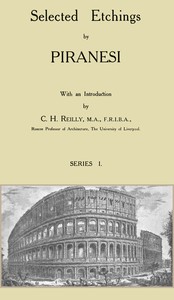
Before opening Selected etchings by Piranesi, series 1. — Story, Setting & Ideas, the edition data offers a quick orientation: 9,150 words, 40 min estimated reading time, and 7 detected text sections.
The text analysis averages about 17.8 words per sentence, while the detected sections provide another way to judge how the source is divided.
Project Gutenberg metadata also associates the work with “Piranesi, Giovanni Battista, 1720-1778,” connecting these edition facts with the source record’s subject description.
Explore this collection
These alternatives are selected using recorded categories and estimated reading time.
About 37 minutes
Architecture
8,432 recorded words. 3 minutes difference from this book's estimate.
View Gutenberg source #58312About 36 minutes
Architecture
8,203 recorded words. 4 minutes difference from this book's estimate.
View Gutenberg source #53127About 36 minutes
Architecture
8,195 recorded words. 4 minutes difference from this book's estimate.
View Gutenberg source #64686Search stored excerpts and compare books → Choose by your preferences →
Choices use stored catalog measurements. Estimates vary with reading speed. A shared category is a catalog label, not a claim that two books have the same argument or literary quality.
Search reads excerpt text stored with this catalog and links to its associated Gutenberg record. The connection is stored in the site database; this tool does not recheck that every excerpt is word-for-word identical to that external record. Excerpt search does not cover every chapter and does not verify historical publication dates.
Catalog snapshot checked: 2026-09-26. Coverage: 93 public books, 93 available source excerpts.
Calculated from edition completeness, EPUB availability, text structure and catalogue metadata. Not a user rating.
Total of 100 points, scaled to a 2.5-5.0 range. Editions with an empty description or a missing EPUB file are not scored.
Public-domain source text
The source text is kept in the dedicated reader, separate from this catalogue record and its commentary.
C. H. Reilly's introduction to this selection of Piranesi's etchings positions the artist at a moment when architectural taste was shifting. Reilly notes that Piranesi's work combines “the actual remains of Roman buildings” with “the fantastic creations of his own brain,” a duality that defines the portfolio. The plates range from measured views of Roman structures—such as the Pantheon interior and the Colosseum—to the “Imaginary Roman Prisons,” where perspective becomes a tool for disorientation rather than documentation.
Reilly’s prose is precise and evaluative, often using terms like “finely executed,” “graceful design,” and “richly wrought” to describe the etchings. He frames Piranesi as a “genius” whose work reflects a time “somewhat similar” to the early twentieth century in architectural ambition. This language suggests an editorial intent to position Piranesi as relevant to contemporary architects, not merely a historical curiosity. Reilly avoids hyperbole, instead grounding his praise in specific observations about line draughtsmanship and composition.
The annotated list of plates reveals a consistent voice: factual yet appreciative. For instance, the “Staircase at Thorpe Hall” is described as “one of the finest examples of a seventeenth-century English staircase, richly wrought and carved.” The descriptions prioritize material and period: “executed in wood,” “dating from the late seventeenth or early eighteenth century.” This voice is that of a connoisseur cataloging artifacts, not a critic interpreting meaning. The absence of emotional language keeps the focus on architectural attributes.
The portfolio is organized into thematic groups: views of Roman buildings, imaginary prisons, vases and tripods, and chimneypieces. This structure highlights Piranesi’s range—from archaeological record to ornamental design. Reilly’s selection emphasizes the architectonic over the purely picturesque. The inclusion of “Design for a Grand Staircase” and “Design for a Sculpture Gallery” alongside measured views suggests an interest in Piranesi as a designer of spaces, not just a recorder of ruins. The final section on chimneypieces from “Diverse Maniere” extends this into applied ornament.
Across the plates, certain motifs recur: monumental scale, dramatic shadow, and intricate detail. The “Imaginary Roman Prisons” employ exaggerated perspective to create vertiginous depth, while the vase plates focus on sculptural form and surface ornament. Reilly’s introduction notes that Piranesi “excels as a specimen of line draughtsmanship,” a quality visible in the crisp contours of the “Trophy of Arms” and the delicate rendering of the “Antique bas-relief from Naples.” The contrast between the solidity of Roman masonry and the fantastical architecture of the prisons is a deliberate authorial choice.
Readers approaching this collection should attend to the interplay between Reilly’s editorial framing and Piranesi’s visual choices. The introduction provides a lens through which to see the etchings as both historical documents and imaginative works. Comparing the measured views with the prison series reveals how Piranesi manipulated scale and perspective to different ends. This edition invites a dual reading: as a record of Roman antiquity and as a testament to architectural fantasy.
That rainy afternoon, Piranesi’s precise ruins made me feel time folding strangely, each arch a quiet threshold. The same stillness surfaced later, unexpectedly, while flipping through a friend’s copy of Heraldry for Craftsmen & Designers — A Closer Reading—not grand decay, but the patient grammar of lions and shields, another language of order trying to outlast its own meaning.
Build a private reading journal entry for this title.









