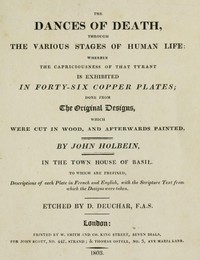
David Deuchar’s 1803 edition of Holbein’s Dances of Death presents forty-six copper plates that pair French and English descriptions with scriptural epigraphs. The engravings, based on Holbein’s original woodcuts from the Town House of Basel, are not mere reproductions; Deuchar’s etching style introduces a distinct linear clarity and tonal range that alters the visual impact of the scenes. The bilingual captions, often diverging in nuance, reveal how the same image could be framed for different audiences. For instance, the French text for Plate XXX describes the judge as “paroît fort occupé” while the English version states he is “deeply engaged,” a subtle shift in emphasis. This note explores how Deuchar’s authorial choices in diction, dialogue, and description shape the moral and aesthetic experience of the work.
Bilingual Captions and Moral Framing
The English and French captions accompanying each plate do not always align in tone or detail. In Plate XXXI, the English description of the Advocate states that “Death will avenge the oppressed” and “is pouring into the hands of the Advocate money in abundance,” whereas the French version says “elle verse abondamment dans les mains de l’Avocat de l’argent” and adds that Death shows “d’un air moqueur son sable écoulé.” The English omits the mocking gesture, softening the critique. Similarly, the scriptural epigraphs—drawn from Proverbs and Matthew—anchor each scene in biblical morality, but the captions sometimes expand the narrative beyond the verse. For Plate XXXII, the English caption invents a “bad customer, Death himself” who “wants to bargain for” the merchant’s person, a dramatic flourish absent from the French “ce n’est que de sa personne qu’elle veut faire emplette.” These discrepancies suggest Deuchar or his collaborators tailored the moral emphasis for each language readership.
Deuchar’s Etching Choices and Visual Rhetoric
Deuchar’s engravings reinterpret Holbein’s woodcuts through the medium of copperplate etching, which allows finer lines and greater tonal variation. In Plate XXXIII, the description notes Death appears “in the form of two skeletons,” one dragging the hawker and the other playing a marine trumpet. The etching likely emphasizes the skeletal forms with stark outlines, contrasting with the hawker’s bent posture. The English caption adds that the skeletons “appear desirous of making him take another road,” a personification that heightens the sense of coercion. Deuchar’s preface praises Holbein’s “invention” and “execution,” but his own plates introduce a theatrical quality: the judge in Plate XXX is described as having a “little devil, astride on his neck,” a detail that the etching must render with precise linework to convey the devil’s whisper. These visual choices—such as the placement of figures and the use of space—guide the viewer’s moral interpretation.
Recurring Motifs of Inattention and Sudden Interruption
Across the excerpts, a pattern emerges: characters are absorbed in worldly affairs and oblivious to Death’s approach. The Counsellor (Plate XXX) “pays no sort of regard to the poor man” while listening to a devil; the Merchant (Plate XXXII) is “employed in counting his money” when Death arrives; the Hawker (Plate XXXIII) is “comforting himself with thinking on the gain.” Death consistently interrupts these moments of absorption, often with a physical gesture—seizing the judge’s wand, pouring money, or dragging an arm. The captions emphasize the suddenness: “Death seems to be rising from the earth, in indignation” (Plate XXX) or “Death himself, comes up” (Plate XXXII). This structural repetition underscores the moral that worldly preoccupations blind individuals to mortality. The scriptural epigraphs reinforce this, as in Proverbs 21:13: “Who stoppeth his ear at the cry of the poor, he also shall cry himself, and shall not be heard.”
The Role of the Poor and the Oppressed in the Scenes
Several plates foreground the poor as silent witnesses or victims of the powerful. In Plate XXX, the poor man “is tapping his shoulder, and in the most suppliant posture asking to be heard,” yet the Counsellor ignores him. Plate XXXI shows the Advocate’s “poor client” standing “in a certain distance,” his “wretched condition” failing to move the lawyer. The English caption for Plate XXXI explicitly states that Death “will avenge the oppressed,” positioning Death as an agent of justice. The French version similarly says “la Mort vengera l’opprimé.” This moral framework aligns with the scriptural epigraphs, such as Proverbs 22:3, which warns the prudent man foresees evil. The poor are not merely background figures; their presence indicts the wealthy and powerful. Deuchar’s descriptions, by detailing their gestures and postures, invite the viewer to sympathize with them, even as Death’s intervention is portrayed as inevitable and just.
Readers approaching this edition should attend to the interplay between text and image, noting where the captions amplify or diverge from the visual scene. The bilingual format offers a unique opportunity to compare moral emphases across languages. Consider how Deuchar’s etching style—with its precise lines and dramatic contrasts—shapes the emotional register of each plate. The work rewards careful study of its details: the posture of a hand, the expression of a skeleton, the placement of a biblical verse. These elements together construct a complex meditation on mortality, power, and justice.
Leafing through Deuchar’s etchings, I kept noticing how each deathly figure paused—a breath held before the final step. It felt oddly like standing in that vast, stone-quiet courtyard, where every corridor also seems to wait for something unspoken. The same weight of time, perhaps, clings to both: The Escorial A Historical and Descriptive Account of the Spanish Royal Palace, Monastery and Mausoleum — Key Ideas to Explore carries that hush in its very stones.