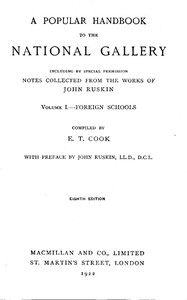
A Popular Handbook to the National Gallery, Volume I, Foreign Schools Including by Special Permission Notes Collected from the Works of John Ruskin — Edition Insights

(0 User reviews)   629
In Category - Painting Sculpture
Cook, Edward Tyas, Sir, 1857-1919 [Compiler], National Gallery (Great Britain) [Contributor], Ruskin, John, 1819-1900 [Contributor] Project Gutenberg 2014 Not confirmed
Painting -- England -- London -- Catalogs; National Gallery (Great Britain) Readers of public-domain and historical texts
Project Gutenberg digital edition en

Edition facts

Words 329,339
Reading time 1432 min
Text sections 54

For A Popular Handbook to the National Gallery, Volume I, Foreign Schools Including by Special Permission Notes Collected from the Works of John Ruskin — Edition Insights, the stored edition analysis reports 329,339 words, 23 hr 52 min estimated reading time, and 54 detected text sections.

The text analysis averages about 17.4 words per sentence, while the detected sections provide another way to judge how the source is divided.

Project Gutenberg metadata also associates the work with “Painting -- England -- London -- Catalogs,” connecting these edition facts with the source record’s subject description.

Explore this collection

Compare your next read

These alternatives are selected using recorded categories and estimated reading time.

Search stored excerpts and compare books → Choose by your preferences →

How these choices and excerpts are prepared

Choices use stored catalog measurements. Estimates vary with reading speed. A shared category is a catalog label, not a claim that two books have the same argument or literary quality.

Search reads excerpt text stored with this catalog and links to its associated Gutenberg record. The connection is stored in the site database; this tool does not recheck that every excerpt is word-for-word identical to that external record. Excerpt search does not cover every chapter and does not verify historical publication dates.

Catalog snapshot checked: 2026-09-26. Coverage: 93 public books, 93 available source excerpts.

A guide to foreign paintings in the National Gallery, blending E. T. Cook's catalog entries with John Ruskin's critical notes. The handbook pairs practical visitor information with aesthetic judgments, contrasting Ruskin's moralistic tone with Cook's factual descriptions. Entries on Van Huysum, Cuyp, and Philippe de Champaigne reveal tensions between precision, universality, and character portrayal.
Share
Editorial Edition Score 4.9/5

Calculated from edition completeness, EPUB availability, text structure and catalogue metadata. Not a user rating.

How this score is calculated
  • Description quality20 pts
  • Title & short description10 pts
  • Source metadata20 pts
  • Text length15 pts
  • Chapters / structure15 pts
  • EPUB file integrity20 pts

Total of 100 points, scaled to a 2.5-5.0 range. Editions with an empty description or a missing EPUB file are not scored.

Edition quality

Public-domain source text

Read the source text

The source text is kept in the dedicated reader, separate from this catalogue record and its commentary.

This handbook juxtaposes two distinct voices: the compiler E. T. Cook's straightforward cataloging and John Ruskin's morally charged aesthetic pronouncements. The opening epigraph from Ruskin declares that 'every noble picture is a manuscript book, of which only one copy exists,' framing the gallery as a library where paintings must be 'read upon their shelves.' Yet the volume also includes practical details such as admission hours and student days, creating a tension between the mundane and the exalted. The preface and notes by Ruskin, included 'by special permission,' inject a prescriptive tone that often overrides Cook's more neutral descriptions.

Ruskin's Moral Lens vs. Cook's Cataloguing

The handbook's structure reveals a fundamental contrast: Cook provides factual entries—dates, signatures, biographical sketches—while Ruskin's interpolated notes demand that viewers seek moral and technical perfection. In the entry on Jan Van Huysum, Ruskin is quoted ranking artists by their pursuit of 'any truth or attainment with all his heart and strength,' placing Van Huysum's precision alongside Titian's colour and Rembrandt's lamplight. Cook, however, simply notes the artist's careful rendering of vases, bird's nests, and eggs, and includes a contemporary artist's effusive praise of Van Huysum's 'pearly dewdrops' and 'tiny ants.' The result is a layered text where the reader must navigate between Ruskin's hierarchical judgments and Cook's more egalitarian, descriptive approach.

The Dutch Masters: Universality and Specialization

Cook's entry on Aelbert Cuyp highlights a recurring theme: the tension between specialization and versatility. Cuyp is praised for his 'universality'—painting skies, clouds, water, cattle, horses, and even portraits with equal skill. The quoted Quarterly Review passage marvels at a single hand capable of such range, placing Cuyp 'between Van der Helst and Rembrandt.' Yet the handbook also celebrates specialists like Van Huysum, whose meticulous flower pieces and bird's nests represent a different ideal: focused precision. This duality reflects a broader debate in art criticism: whether breadth or depth constitutes greater mastery. Cook's selection of excerpts, including a letter from artist James Smetham, leans toward admiring the specialist's devotion to detail, even as the Cuyp entry extols versatility.

Portraiture and Character: Philippe de Champaigne's Richelieu

The entry on Philippe de Champaigne's portrait of Cardinal Richelieu offers a case study in how the handbook reads character from visual evidence. Cook notes that the painting was made for a sculptor to use as a model, hence the inclusion of two profiles alongside the full face. Over one profile, an inscription declares it the better likeness. Cook then interprets the features: 'compressed lips, the merciless eyes, the iron-gray hair and prominent nose' bespeak a certain temperament. This moment of physiognomic reading contrasts with the more neutral biographical data provided earlier. It also echoes Ruskin's moralistic approach, though Cook's language remains descriptive rather than prescriptive. The entry thus demonstrates how the handbook moves between objective fact and subjective interpretation, inviting readers to engage in their own scrutiny of painted character.

Readers of this handbook will find themselves shuttling between two modes of looking: Ruskin's demand for moral and technical hierarchy, and Cook's more patient, fact-gathering cataloguing. The volume rewards those who attend to its internal contradictions—where a painter's precision is both celebrated as a virtue and ranked below other virtues. Rather than a unified guide, it offers a record of how late-Victorian connoisseurship negotiated between admiration and judgment, between the gallery as a space of instruction and as a place of personal encounter.

That rainy afternoon, I kept returning to Ruskin’s sharp little asides in the handbook, especially his fussing over Cuyp’s golden light. It made me think how children in paintings rarely get that same moral scrutiny. Afterwards, I found myself browsing Child-life in Art — Context and Discussion, and realized its quieter gaze felt like a natural sequel to those gallery notes.

There are no reviews for this eBook.

0
0 out of 5 (0 User reviews )

Add a Review

Your Rating *
There are no comments for this eBook.

Reader reflection

Before you leave, reflect on the book

Use these questions to collect your thoughts before moving on.

Your progress 0 / 10
1

Where are you in your reading?

2

Did this book hold your interest?

3

Would you encourage someone else to read it?

4

What was the reading difficulty like?

Related eBooks