About 104 minutes
Drawings of Old London — A Closer Reading
Painting Sculpture
23,812 recorded words. 1 minutes difference from this book's estimate.
View Gutenberg source #58715
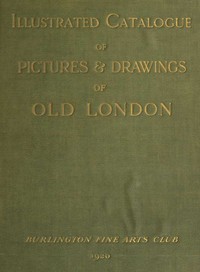
Before opening Catalogue of a collection of early drawings and pictures of London: With some contemporary furniture — A Closer Reading, the edition data offers a quick orientation: 23,489 words, 1 hr 43 min estimated reading time, and 12 detected text sections.
The text analysis averages about 12.5 words per sentence, while the detected sections provide another way to judge how the source is divided.
Project Gutenberg metadata also associates the work with “Art -- Exhibitions,” connecting these edition facts with the source record’s subject description.
Explore this collection
These alternatives are selected using recorded categories and estimated reading time.
About 104 minutes
Painting Sculpture
23,812 recorded words. 1 minutes difference from this book's estimate.
View Gutenberg source #58715About 97 minutes
Painting Sculpture
22,178 recorded words. 6 minutes difference from this book's estimate.
View Gutenberg source #29647About 87 minutes
Painting Sculpture
19,934 recorded words. 16 minutes difference from this book's estimate.
View Gutenberg source #25268Search stored excerpts and compare books → Choose by your preferences →
Choices use stored catalog measurements. Estimates vary with reading speed. A shared category is a catalog label, not a claim that two books have the same argument or literary quality.
Search reads excerpt text stored with this catalog and links to its associated Gutenberg record. The connection is stored in the site database; this tool does not recheck that every excerpt is word-for-word identical to that external record. Excerpt search does not cover every chapter and does not verify historical publication dates.
Catalog snapshot checked: 2026-09-26. Coverage: 93 public books, 93 available source excerpts.
Calculated from edition completeness, EPUB availability, text structure and catalogue metadata. Not a user rating.
Total of 100 points, scaled to a 2.5-5.0 range. Editions with an empty description or a missing EPUB file are not scored.
Public-domain source text
The source text is kept in the dedicated reader, separate from this catalogue record and its commentary.
The catalogue records an exhibition held at the Burlington Fine Arts Club in 1920, presenting early views of London alongside examples of contemporary furniture. Compiled under a committee that included Philip Norman, who also contributed an introduction, the volume lists over 400 works lent by royalty, institutions, and private collectors. The entries combine topographical description, architectural history, and art-historical attribution, often noting discrepancies between frame labels, captions, and indexes—as when Plate XLI is attributed to Canaletto in the index but to Samuel Scott in the text. These editorial annotations reveal the curators' careful, sometimes uncertain, scholarship.
The catalogue repeatedly signals doubts about authorship. Entry 79, an oil painting of Old Blackfriars Bridge, is noted as “wrongly called on the frame ‘Southwark Bridge,’” a bridge not built until 1815. The same entry questions the date 1808 for work by R. Burford, who was born in 1792 and would have been only sixteen. Plate XLI (No. 94) is attributed to Canaletto in the index and to Samuel Scott in the text and caption; Plate XLII (No. 95) shifts from Samuel Scott to Nattes. The transcriber’s note flags “notoriety as forger” as a possible misprint. These details show the catalogue as a working document, not a definitive statement.
Entries consistently anchor each view in specific locations and historical changes. The Mansion House (No. 75) is described as built on the site of Stocks Market, with its top story, “familiarly known to cockneys as ‘the Mare’s Nest,’” removed in 1842. The East India House (No. 77) is traced through its architects Richard Jupp and H. Holland, and its pediment sculpture by John Bacon. The water pageant (No. 78) is identified as the Lord Mayor’s procession to Westminster, with landmarks like old Somerset House, St. Mary-le-Strand, St. Paul’s, the Monument, and old London Bridge before the removal of houses. Such detail makes the catalogue a resource for reconstructing lost urban fabric.
Although the title includes “some contemporary furniture,” the excerpts provided focus almost entirely on the drawings and pictures. The committee list includes Oliver Brackett, a noted furniture historian, and the catalogue’s full text likely contains furniture entries that parallel the art entries in descriptive rigor. The inclusion of furniture alongside topographical views suggests the exhibition aimed to present a holistic material culture of early modern London, though the surviving excerpts offer only hints of this dimension. Readers seeking the furniture content will need to consult the complete catalogue.
This catalogue rewards readers interested in the history of London’s built environment and the practices of early twentieth-century connoisseurship. The entries are dense with architectural and topographical detail, while the editorial notes offer a candid view of the limits of attribution. For full benefit, read the introduction by Philip Norman and compare entries with the plates, where available.
Leafing through this 1920 catalogue, I’m struck by how much care went into noting what might vanish—the very streets and chairs the curators loved enough to question. It makes me think of The preservation of antiquities — Text and Context, that quieter plea for tenderness toward old things. We’re still holding on, aren’t we? Just differently now.
Answer a few questions and save a private reflection on this device.