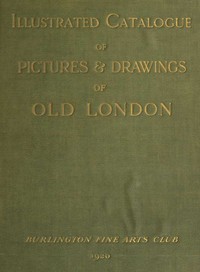
Drawings of Old London — A Closer Reading

(0 User reviews)   1692
In Category - Painting Sculpture
Norman, Philip, 1842-1931, Smith, Cecil Harcourt-, Sir, 1859-1944 [Author of introduction, etc.] Project Gutenberg 2019 Not confirmed
Drawing -- England -- London -- Catalogs; London (England) -- Pictorial works -- Catalogs Readers of public-domain and historical texts
Project Gutenberg digital edition en

Edition facts

Words 23,812
Reading time 104 min
Text sections 8

Drawings of Old London — A Closer Reading can be approached with a clearer sense of reading commitment from its source measurements: 23,812 words, 1 hr 44 min estimated reading time, and 8 detected text sections.

The text analysis averages about 18.7 words per sentence, while the detected sections provide another way to judge how the source is divided.

Project Gutenberg metadata also associates the work with “Drawing -- England -- London -- Catalogs,” connecting these edition facts with the source record’s subject description.

Explore this collection

Compare your next read

These alternatives are selected using recorded categories and estimated reading time.

Search stored excerpts and compare books → Choose by your preferences →

How these choices and excerpts are prepared

Choices use stored catalog measurements. Estimates vary with reading speed. A shared category is a catalog label, not a claim that two books have the same argument or literary quality.

Search reads excerpt text stored with this catalog and links to its associated Gutenberg record. The connection is stored in the site database; this tool does not recheck that every excerpt is word-for-word identical to that external record. Excerpt search does not cover every chapter and does not verify historical publication dates.

Catalog snapshot checked: 2026-09-26. Coverage: 93 public books, 93 available source excerpts.

Philip Norman's 1913 catalogue of his drawings of London architecture, many since demolished, with precise descriptions of buildings, their histories, and the urban changes they witnessed.
Share
Editorial Edition Score 4.7/5

Calculated from edition completeness, EPUB availability, text structure and catalogue metadata. Not a user rating.

How this score is calculated
  • Description quality20 pts
  • Title & short description10 pts
  • Source metadata20 pts
  • Text length15 pts
  • Chapters / structure15 pts
  • EPUB file integrity20 pts

Total of 100 points, scaled to a 2.5-5.0 range. Editions with an empty description or a missing EPUB file are not scored.

Edition quality

Public-domain source text

Read the source text

The source text is kept in the dedicated reader, separate from this catalogue record and its commentary.

Philip Norman's Drawings of Old London is a catalogue of architectural drawings he made 'in almost every case from the actual buildings,' many of which were later demolished or altered. Published in 1913 by the Victoria and Albert Museum, the work records domestic and commercial structures—inns, wharves, houses—that defined London's pre-modern streetscape. Norman's descriptions combine precise dimensions, historical anecdotes, and observations on construction, often noting the fate of each site. The catalogue reveals a city in transition, where a 300-year-old house could still be let in apartments in 1891, only to be destroyed seven years later.

Inns as Urban Landmarks

The catalogue opens with several Southwark inns: the Queen's Head, White Hart, Nag's Head, and King's Head. Norman records their architectural features—galleries, courtyards, signs—and their roles in coaching and trade. The Elephant and Castle at Newington Butts, for instance, is noted as a 'well-known halting station for omnibuses and tramcars,' and Norman mentions a claim that Shakespeare referenced it in Twelfth Night. He does not endorse the claim, but presents it as part of the building's lore. These entries show how inns functioned as nodes in London's transport network, their signs and structures evolving over centuries.

Riverside Life and Lost Structures

Norman's drawing 'View from Paul's Pier' (1891) captures a 'curious riverside dwelling' squeezed between warehouses, with a bay window over a doorway opening onto the Thames. He notes the house contained nineteen rooms and two staircases, and was 'one of the last of its kind on the Thames bank.' The description includes a subterranean brick tunnel discovered nearby, possibly built to carry off torrents after heavy rain. Norman cites a Builder article linking the tunnel to a 1574 flood story by Stow. The house, the 'barracks' warehouse, and the tunnel were all destroyed in 1898. Such details emphasize the fragility of London's built heritage.

Marks, Tokens, and Traces

Norman frequently includes small material evidence: trade tokens, swan marks, and architectural remnants. In the entry for the 'Swan with Two Necks' sign, he explains the origin of the name from the Vintners' swan mark—a chevron and two nicks—and notes that the marking practice was prosecuted by the RSPCA in 1878. A seventeenth-century token from Paul's Wharf is transcribed: 'AT . Y E . NEXT . BOAT . BY PAVLS.' These fragments—coins, carvings, tunnels—anchor Norman's drawings in a tangible past, showing how everyday objects and customs left traces in the urban fabric.

Norman's catalogue rewards readers who attend to its specific, often melancholy details: a house's room count, the date of a demolition, the text of a token. The drawings themselves are not reproduced here, but the descriptions conjure vanished corners of London with precision. For those interested in architectural history or the city's transformation, this work offers a focused, evidence-rich record of what was lost—and what was deemed worth preserving in 1913.

Philip Norman’s lean drawings made me think of my grandfather’s taped-together sketchbooks, little doorways he loved that vanished by the seventies. It’s strange how a precise line can hold so much absence. That same steady ache surfaced once in Earthwork Slips and Subsidences upon Public Works Their Causes, Prevention, and Reparation — Reading Notes, where the ground itself remembers what we build upon it.

There are no reviews for this eBook.

0
0 out of 5 (0 User reviews )

Add a Review

Your Rating *
There are no comments for this eBook.

Reader reflection

How did this book work for you?

Your answers remain private and are stored only in this browser.

Your progress 0 / 10
1

What is your current status with this title?

2

Was reading this book enjoyable?

3

How likely are you to recommend this book?

4

How demanding did the text feel?

Related eBooks