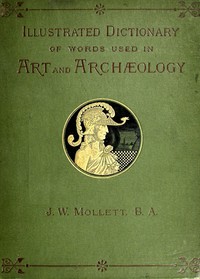
J. W. Mollett’s An Illustrated Dictionary of Words used in Art and Archaeology (1883) opens with a preface that immediately clarifies its lineage: it began as an amended edition of Ernest Bosc’s French work, but Mollett’s revisions have left “little or nothing … of the text of M. Bosc’s work … standing.” The dictionary thus claims independence while retaining Bosc’s 450 engravings, to which Mollett added about 250 more. This hybrid origin shapes the book’s character: it is a translation and expansion, but also a selective reworking that privileges certain fields—architecture, Christian antiquities, medieval armour, costume, heraldry, pottery—over the Greek and Roman antiquities that dominated Bosc’s original. The preface warns that classical terms have been “reduced to the smallest possible compass,” directing readers to Smith and Rich for fuller definitions.
Architecture as the Backbone
The preface gives “considerable prominence … to Architecture,” and the sample entries bear this out. Terms like intercolumniation, intermodillions, and intertignium appear in quick succession, each defined with precise architectural context. For instance, intercolumniation is explained as varying “according to the orders of architecture,” and the entry notes that in ancient temples the space facing the door is wider than at the sides. Such details reflect Mollett’s reliance on “English writers” to correct the French original. A first-time reader should note that architectural terms often include cross-references (e.g., aerostyle, eustyle) and are accompanied by figures—though the excerpts do not reproduce the engravings. The dictionary’s structure rewards browsing: definitions are concise but packed with technical vocabulary, and the reader may need to follow cross-references to grasp the full system.
Christian and Classical Crossings
Mollett’s treatment of Christian antiquities draws on Martigny and the dictionary of Smith and Cheetham. The entry for Infula illustrates this dual focus: it first gives the Roman meaning—“a flock of red and white wool worn by priestesses and vestals”—then adds a Christian sense: “Ribands hanging from a bishop’s mitre.” This pattern recurs throughout: classical terms are often followed by a Christian application, marked by “Chr.” The reader should watch for such layered definitions, which reveal Mollett’s interest in continuity and transformation. Similarly, Insensati of Perugia—an Italian literary academy—is defined not by its classical roots but by its device: cranes with stones and sand, with mottoes from Pliny. These entries show the dictionary’s range beyond strict art and archaeology into emblem and literary culture.
Heraldry and the Language of Devices
Heraldic terms are given particular attention, with sources including Boutell and Mrs. Bury Palliser. The entry for In Pride defines it as “Having the tail displayed, as a peacock’s,” and illustrates with the device of Joan of Castile: “A peacock, in his pride, upon the terrestrial globe.” The phrasing is terse but evocative. Similarly, In Glory is simply “The sun irradiated,” and In Lure describes “Wings conjoined, with their tips drooping.” These definitions assume a reader familiar with blazonry; a newcomer may need to consult the preface’s list of authorities. The dictionary also includes terms like In Pretence (“Placed upon, and in front of”), which are purely positional. The heraldic entries are among the most visually suggestive, and the reader should imagine the accompanying engravings (not shown in the excerpts) that likely clarify these postures.
Pottery, Colour, and the Material World
Mollett’s preface notes that articles on pottery derive from M. Jacquemart’s work, and colour terms are drawn from specialized sources. In the sample, Intense Blue is defined as “A preparation of indigo, very durable and transparent,” and Intense Madder Purple cross-references to Madder. These entries are brief but technical, reflecting the dictionary’s aim to serve practitioners as well as readers. The inclusion of Inlaying (“Inserting ornaments in wood-work for decorative furniture”) with cross-references to Boule and Marquetry shows how the dictionary connects material techniques. A first-time reader interested in decorative arts will find these entries scattered but rewarding; the preface’s list of subjects—arms, bronzes, costume, lace, personal ornaments—hints at the breadth. The dictionary is not exhaustive, but it offers a Victorian compendium of practical and historical knowledge.
Mollett’s dictionary is best approached as a reference to be dipped into rather than read straight through. The preface provides a clear map of its strengths and limitations, and the sample entries show how it balances multiple specialties. A reader curious about a specific term—say, Inti-huasi or Insignia—will find a concise definition with etymological and contextual notes. The engravings, though not reproduced here, are integral to the work; the text often refers to figures (e.g., “Fig. 282”). For a first reading, start with the preface, then sample entries in a field of interest, and follow cross-references to gauge the dictionary’s interconnectedness.
That rainy afternoon, Mollett’s dictionary kept pulling me toward the human stories behind terms like “nimbus” and “fold”—the hands that painted them. I found myself wishing for softer ground, less definition. Later, still caught in that mood, I stumbled on Child-life in Art — Context and Discussion, where the same vocabulary falls away, leaving only wonder.