About 217 minutes
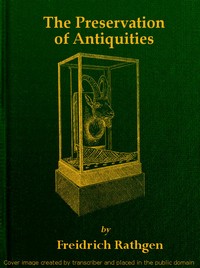
The preservation of antiquities — Text and Context
Painting Sculpture
49,811 recorded words. 35 minutes difference from this book's estimate.
View Gutenberg source #46851
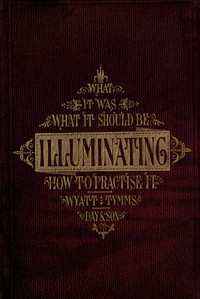
The source record for The History, Theory, and Practice of Illuminating Condensed from 'The Art of Illuminating' by the same illustrator and author — Background and Themes measures this digital text at 57,934 words, 4 hr 12 min estimated reading time, and 9 detected text sections.
The text analysis averages about 26.2 words per sentence, while the detected sections provide another way to judge how the source is divided.
Project Gutenberg metadata also associates the work with “Illumination of books and manuscripts,” connecting these edition facts with the source record’s subject description.
Explore this collection
These alternatives are selected using recorded categories and estimated reading time.
About 217 minutes
Painting Sculpture
49,811 recorded words. 35 minutes difference from this book's estimate.
View Gutenberg source #46851About 164 minutes
Painting Sculpture
37,674 recorded words. 88 minutes difference from this book's estimate.
View Gutenberg source #47837About 371 minutes
Painting Sculpture
85,299 recorded words. 119 minutes difference from this book's estimate.
View Gutenberg source #56132Search stored excerpts and compare books → Choose by your preferences →
Choices use stored catalog measurements. Estimates vary with reading speed. A shared category is a catalog label, not a claim that two books have the same argument or literary quality.
Search reads excerpt text stored with this catalog and links to its associated Gutenberg record. The connection is stored in the site database; this tool does not recheck that every excerpt is word-for-word identical to that external record. Excerpt search does not cover every chapter and does not verify historical publication dates.
Catalog snapshot checked: 2026-09-26. Coverage: 93 public books, 93 available source excerpts.
Calculated from edition completeness, EPUB availability, text structure and catalogue metadata. Not a user rating.
Total of 100 points, scaled to a 2.5-5.0 range. Editions with an empty description or a missing EPUB file are not scored.
Public-domain source text
The source text is kept in the dedicated reader, separate from this catalogue record and its commentary.
The manual opens not with abstract theory but with a series of plates that immediately ground the reader in historical practice. Plate I, from the Bible of Charles the Bald, is described as offering a style 'of comparatively easy execution' suitable for a young illuminator's ''prentice hand.' Plate II then provides the outline for Plate I, inviting the beginner to make a first attempt at coloring. This pairing of exemplar and outline recurs throughout the early plates, establishing a learn-by-copying approach that defines the book's pedagogy.
The authors also note that the scriptural texts in the plates have been deliberately chosen for 'embellishment of churches or schoolrooms,' signaling a practical, applied purpose. The reader is thus positioned as both student and potential practitioner from the very first pages.
The sequence of plates in the opening chapters functions as a graded curriculum. Plate III offers alphabets and an interlacement pattern from the Saxon school, while Plate IV introduces Romanesque forms from a 12th-century manuscript, where 'the scroll may be observed as having almost entirely superseded the Carlovingian interlacement.' The commentary points out specific features—such as the 'germination of Gothic' in foliated stem ends—that train the eye to recognize stylistic evolution. Each plate is paired with an outline version for coloring practice, reinforcing the idea that historical study and manual exercise are inseparable. The reader is not merely looking at examples but being guided to reproduce them, building skill through imitation.
Later in the volume, the authors condense their advice into seven numbered rules that address common pitfalls. Rule four warns that critics 'will estimate your powers, not by your best page, but by a mean struck between your best and your worst,' emphasizing consistency over isolated brilliance. Rule five advises against mixing natural and conventional foliage: 'Adopt which you like, for by either beautiful effects may be produced; but mix them, and the charm of both is gone.' Rule six stresses keeping dominant lines parallel to page edges to prevent a 'straggling and untidy appearance.' These rules are concrete, experience-based directives that a first-time illuminator can apply immediately, and they reveal the authors' deep familiarity with the craft's practical demands.
The seventh rule touches on colour harmony, but the authors caution that theory alone is insufficient: 'it would be as foolish to expect a man to be a good performer upon any instrument, because he had learnt the theory of music, as it would be to suppose that he must necessarily paint in harmonious colouring.' They insist that constant experiment and practice are essential, and that 'to the experienced eye and hand, functions become intuitive.' This passage underscores the manual's philosophy: historical knowledge and technical rules are necessary but not sufficient; the reader must develop tactile fluency through repeated effort. The discussion of tracing-paper as an intermediate surface for both oil and water colour further illustrates the authors' focus on adaptable, real-world techniques.
The final excerpt shifts to materials and methods, describing how illumination can be applied to 'book or picture enrichment' or 'mural illumination.' The authors note that tracing-paper allows those 'not sufficiently advanced in design or drawing' to copy correctly, acknowledging a range of skill levels among readers. This practical turn, after the historical survey and rule-giving, completes the arc from observation to execution. A first-time reader who has worked through the plates and rules will find here the technical details needed to begin their own projects. The manual thus functions as a self-contained course, moving from inspiration through instruction to implementation, without assuming prior expertise.
For a first reading, pay close attention to the interplay between the plates and the text: the historical examples are not mere illustrations but the core of the learning method. The rules and technical notes are best absorbed alongside hands-on practice, as the authors intend. Readers interested in the craft's history will find the plate commentaries informative, but the manual's true value lies in its insistence that understanding comes through making.
Tucked between those plates of gold-leafed initials, I found myself thinking about how we cling to things — handmade, fragile, precious. The manual’s careful instructions feel like a conversation with someone who knew their work would outlast them. That same quiet devotion haunts The preservation of antiquities — Text and Context, a book I keep returning to, like checking on an old friend’s steady hands. Both whisper the same gentle truth: we simply hold on, as long as we can.
A brief reflection can help important ideas stay with you longer.