About 217 minutes
The preservation of antiquities — Text and Context
Painting Sculpture
49,811 recorded words. 53 minutes difference from this book's estimate.
View Gutenberg source #46851
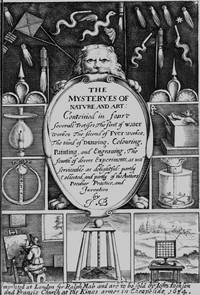
For The Mysteryes of Nature and Art Conteined in foure severall Tretises, The first of water workes, The second of Fyer workes, The third of Drawing, Colouring, Painting — Background and Themes, the stored edition analysis reports 37,674 words, 2 hr 44 min estimated reading time, and 6 detected text sections.
The text analysis averages about 36.7 words per sentence, while the detected sections provide another way to judge how the source is divided.
Project Gutenberg metadata also associates the work with “Science -- Early works to 1800,” connecting these edition facts with the source record’s subject description.
Explore this collection
These alternatives are selected using recorded categories and estimated reading time.
About 217 minutes
Painting Sculpture
49,811 recorded words. 53 minutes difference from this book's estimate.
View Gutenberg source #46851About 104 minutes
Painting Sculpture
23,812 recorded words. 60 minutes difference from this book's estimate.
View Gutenberg source #58715About 103 minutes
Painting Sculpture
23,489 recorded words. 61 minutes difference from this book's estimate.
View Gutenberg source #68989Search stored excerpts and compare books → Choose by your preferences →
Choices use stored catalog measurements. Estimates vary with reading speed. A shared category is a catalog label, not a claim that two books have the same argument or literary quality.
Search reads excerpt text stored with this catalog and links to its associated Gutenberg record. The connection is stored in the site database; this tool does not recheck that every excerpt is word-for-word identical to that external record. Excerpt search does not cover every chapter and does not verify historical publication dates.
Catalog snapshot checked: 2026-09-26. Coverage: 93 public books, 93 available source excerpts.
Calculated from edition completeness, EPUB availability, text structure and catalogue metadata. Not a user rating.
Total of 100 points, scaled to a 2.5-5.0 range. Editions with an empty description or a missing EPUB file are not scored.
Public-domain source text
The source text is kept in the dedicated reader, separate from this catalogue record and its commentary.
John Bate opens his 1634 compendium with an apology: the treatise 'hath lien by mee a long time, penned, but in a confused and undigested manner'. He claims to have been forced into publication by the entreaties of friends, and warns readers to 'expect no elegancy of phrase'. This defensive posture is itself a clue to the book's character—a practical manual that values clarity over polish, yet one that the author clearly considers his own invention and practice.
The work is divided into four books: waterworks, fireworks, drawing and painting, and a final section of miscellaneous experiments called 'Extravagants'. The excerpts show a writer who moves between direct instruction and personal reflection, often addressing the reader directly. The language is plain but not artless, and the author's voice emerges through his choices of what to emphasize and how to guide the reader's hand.
Bate's address 'To the Reader' sets a tone of humility and practicality. He admits the work was originally 'confused and undigested', and that he has only now 'dispose[d] in some order such Experiments as for the present I was content to impart'. This framing suggests a writer who is aware of his audience's needs—he writes 'in plaine termes' so that it 'might suit with the meanest capacity'. Yet the apology also serves as a claim to authenticity: these are not borrowed recipes but practices gathered 'by industry and experience'.
The prefatory poem by a friend, 'Clim', praises Bate's 'active minde' and 'vast industry', calling the book 'the timely fruits of thy vast industry'. This external validation reinforces the author's self-presentation as a diligent practitioner. The reader is positioned as a collaborator, one who must 'scan over with a busy eye' the contents. Bate's hope for 'generall acceptance' is tempered by a realistic shrug: 'hap as hap may be'. This mixture of earnestness and defensiveness gives the opening a distinctive voice, one that is both inviting and wary.
The third book, on drawing and painting, shows Bate at his most methodical. He begins by declaring the art 'most excellent' and 'most worthy commendations', but quickly moves to practicalities: 'first therefore provide good smooth and cleare paper, divers plummets made of blacke leade, oker, or blacke chalke, or else Charcoals made of Ash, Sallow, or Beech'. The list of materials is precise, and the instructions follow a clear sequence: draw 'rustically' with charcoal, check proportions, wipe out faults, then refine with black chalk. Bate even specifies the tool for erasing—'a wing'—and the type of wood for charcoal.
His advice is grounded in experience: 'the sight of a good draught is more unto an ingenious person, then a whole Chaptor of Information'. This remark reveals his belief in visual learning over verbal explanation. He also offers shortcuts for those 'loath to bestow any time to practise', such as tracing through oiled paper. The voice here is that of a teacher who has tried both the difficult and the easy paths, and who is willing to share both. The instructions are not merely technical; they carry the weight of someone who has struggled with the medium.
The fourth part, titled 'Extravagants', is described as containing 'severall Experiments, as well serviceable as delightfull' that are 'confusedly intermixed'. This admission of disorder is characteristic of Bate's honesty about his method. The word 'Extravagants' itself suggests a collection of wanderings or digressions, things that did not fit neatly into the earlier categories. The excerpts do not include this section, but the author's description hints at a playful, less structured approach—perhaps a place for curiosities and practical jokes alongside useful recipes.
Bate's willingness to include such a section shows his awareness that not all knowledge fits into tidy compartments. The 'Extravagants' may be where the book's voice becomes most personal, as the author allows himself to stray from the systematic. This structural choice mirrors the 'confused and undigested' state he mentioned in the preface, and it gives the work a sense of spontaneity. The reader is invited to browse, to pick and choose, much as the author himself gathered his materials over time.
Bate's 'Mysteryes of Nature and Art' rewards a reader willing to move between its four books and the final miscellany. The author's voice is consistent: plain, direct, and grounded in practice. He does not claim to be a polished writer, but his instructions are clear and his enthusiasm for his subjects is evident. Readers interested in the history of technology or early modern craft manuals will find here a work that is both instructive and revealing of its author's character. Approach it as Bate himself suggests—with a 'busy eye' and a willingness to learn from experience.
There’s something tender about John Bate apologizing for his “confused” method, as if usefulness alone should excuse a little mess. I found myself thinking of that while leafing through Child-life in Art — Context and Discussion—not because the two have much in common, but because both feel like quiet handprints left on a windowsill. No grand design, just someone’s honest attempt to hold a moment still.
Create a short personal record of your experience with this book.